
One of the primary themes of court system interdependence is resource dependence — the idea that courts rely on outsiders to provide some of the key resources they need to operate. Those resources include not only quantifiable goods like money, judges, and courthouses, but also “soft” resources like fair, accurate, and unbiased reporting about the courts and their activities. When the media fails to provide this core resource, public trust in the courts can suffer.
Two recent examples demonstrate the problem.
The first example is the singular voice with which the media championed the confirmation of President Biden’s 235th federal judicial appointment. It wasn’t about the qualities of the new judge (Serena Murillo for the Central District of California), but rather that it meant Biden had surpassed Donald Trump’s 234 judicial appointments during his first term.
This is a story only because Trump is such a divisive figure, and Biden topping his number of judicial confirmations feels like a satisfying poke in Trump’s eye for the left-leaning mainstream media. But consider the message it sends about the federal courts. As framed, the story reinforces that judges should be bean-counted like partisan politicians. The same progressive media that (rightly) chastised Trump for suggesting that there were Trump judges and Obama judges in 2017 now celebrates that there is one more “Biden judge” than “Trump judges.” All of this makes is more difficult for the public to have faith that the judiciary is fair and impartial.
The second example concerns today’s reporting on President Biden’s decision to grant clemency to 37 federal death row inmates. (Only three — the particularly notorious Dylann Roof, Dzokhar Tsarnaev, and Robert Bowers, will remain on death row.) The New York Times provided a sentence or two on each inmate and the crime(s) for which he received the death penalty. The summaries are surprisingly anodyne. Here is one:
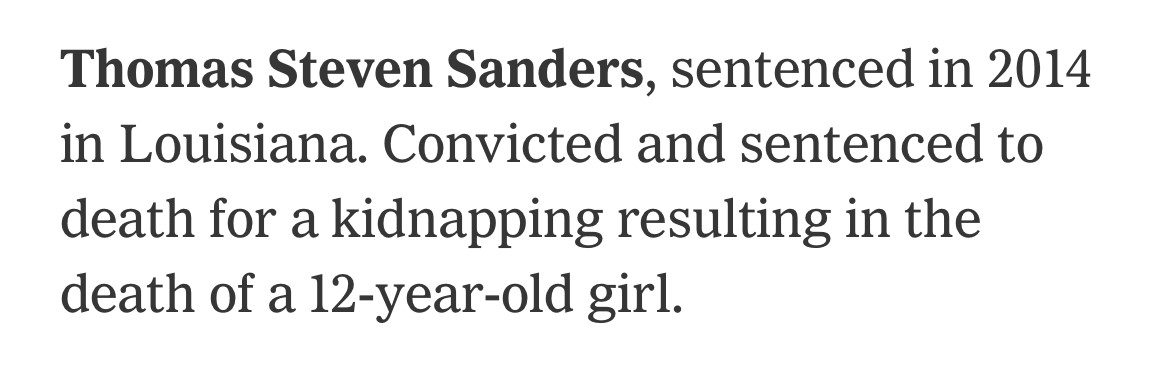
The use of the passive voice — “kidnapping resulting in the death” — deliberately obscures the monstrous behavior for which Sanders was convicted and sentenced to death. He killed Suellen Roberts, then kidnapped her 12-year-old daughter Lexis, eventually brutally murdering Lexis and mutilating her body before dumping in federal forest land. Federal prosecutors and a federal jury had to present and carefully weigh the horrifying details in a 2014 trial before concluding that Sanders should face capital punishment. The US Attorney’s press release at the time gives a flavor of the emotional difficulty of the case and the relief (if not closure) that the victim’s family felt at its end.
This is but one example. The Times glossed over the brutal details of the crimes for each prisoner whose sentence was commuted. Calculated and violent murders of witnesses, children, and countless innocents were reduced to one or two passive sentences.
Now the Times opposes the death penalty (like many Americans) and celebrates Joe Biden (unlike many Americans). The reporters in its newsroom are entitled to be happy about the clemency decisions if they wish. But eliding the brutality of each convict’s actions insults the system that brought these monsters to justice. And anyone involved in the criminal trials — whether as a juror, a witness, an officer of the court, or simply an interested observer — likely feels diminished today, both by Biden’s decision and the Times‘s casual disregard for their efforts.
In the end, such biased reporting will likely hurt news outlets more than the courts — and indeed, surveys show that in this new era of yellow journalism, the mainstream media has earned a much lower level of public trust than does the judiciary. But the collateral damage to the courts that comes with the media’s self-immolation should not be ignored.
 The Interdependent Third Branch