Connecticut ends newspaper publication of court notices

Pennoyer v. Neff noticeThe Hartford Courant reports that the Connecticut state courts will no longer require parties to publish court notices in local papers, effective January 2. Instead, notices will be published in a dedicated court website.

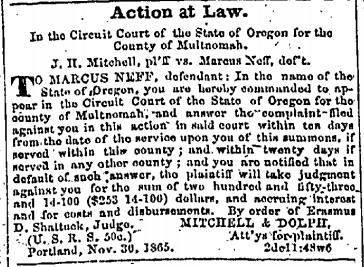
The practice of court notice by publication, sometimes called constructive notice, goes back centuries. It is designed to assure that all interested parties are informed of legal proceedings, especially when those parties cannot be found personally. Indeed, constructive notice played a central role in two of the most famous Supreme Court cases in history. In Mullane v. Central Hanover Bank & Trust Co. (1950), the Court signed off on constructive notice for parties who could not be reasonably ascertained at the time the suit was filed. In Pennoyer v. Neff (1877), the infamous bane of many a first-year law student, the Court based its personal jurisdiction analysis on the premise that constructive notice alone was not enough for the Oregon courts to exercise power over an out-of-state defendant.

Constructive notice is founded on the assumption that if notice is published somewhere, the interested parties are reasonably likely to learn about the proceeding. That itself is a bit of a fiction — the notice in Pennoyer v. Neff was published in a local religious publication called the Pacific Christian Reporter — hardly a paper of major import or geographical reach. But with the unquestioned dominance of the internet in our lives, and the ongoing struggles of the newspaper industry, it is probably more fair to post notices online that in the paper anyway. Newspaper publishers might be rightly angry about the development, but with 2020 on the horizon, it seems sensible for the Connecticut courts to embrace the twenty-first century.

Pictured: The newspaper notice in Pennoyer v. Neff

Should Supreme Court Justices have to ride circuit?

That is the proposal advanced by Kyle Sammin at The Federalist. Sammin recognizes the folly of term limits for Supreme Court Justices, which would require the practical impossibility of a constitutional amendment. Instead, he suggests that we might promote more frequent turnover by requiring Justices to once again “ride circuit” — the 18th and 19th century practice of having Justices travel across the country to hear more ordinary cases during breaks in the Court’s regular term. Sammin states:

Restoring circuit duties to the Supreme Court would provide a natural way of decreasing tenure on the bench. Travel is not as difficult in 2019 as it was in 1819, but it can still be exhausting. If circuit riding had still been a part of the job, infirm justices such as William O. Douglas, William Brennan, and John Paul Stevens would have left the bench before they were fully in decline. Ginsburg would likely have retired a decade ago, as many on the left wish she had. Instead, arrogance and ease lead to justices remaining in their jobs when they are not up to the tasks appointed to them.

I am intrigued by this proposal, although I am not as optimistic that the additional travel burden would put off any but the most frail Justices. The Court’s current members — even those well into their eighties — are already frequent travelers. They speak at law schools, promote their books, accept cozy summer teaching positions, and so on. Open Secrets, for example, found that in 2018 the Justices collectively took 64 trips that were paid for by others. Justice Ginsburg alone took a dozen trips to far-flung places around the world. And even though riding circuit would involve real judicial work rather that quasi-legal junkets, it seems fair to say that all the Justices truly enjoy their day jobs.

What do you think, readers?

The costs of judicial interdependence, Part I

First in an occasional series on how organizational interdependence affects the judiciary

Two recent stories illustrate how the structural interdependence of courts within a constitutional system can drive judicial choices and behaviors.

We start in Sandusky, Ohio, where Common Pleas Judge John Dewey appointed his personal court administrator as a deputy court clerk, a position that would allow the administrator to handle all filings in a sensitive case involving allegations of sexual assault. Judge Dewey further decreed that the case filings should remain sealed, meaning that the newly appointed deputy court clerk would be the sole gatekeeper of the records.

The decision angered the local media, which asserted a First Amendment right of access to the filings. This was not an ordinary case of sexual assault: the defendant was the local district attorney, and the public had an interest in the proceedings. To complicate matters further, under Ohio law court records are supposed to be handled by an elected official. Judge Dewey’s administrator was not elected, and Judge Dewey apparently did not inform the elected court clerk about his preferred arrangement. This decision caused enormous confusion in the clerk’s office, both as to why he did not tell the elected clerk what he was doing, and as to whether Dewey’s decision to appoint a deputy court clerk was even legal.

It is also unclear why Judge Dewey had been given the case, given that the defendant was a regular–indeed, institutional–participant in the Sandusky County court system. Typically, when a local attorney or judge is involved as a party in litigation, the case is assigned to a judge unaffiliated with that jurisdiction to prevent a judicial conflict of interest. Somehow, though, Dewey held on to the case for months even though it created a visible conflict with other cases on his docket that had been brought by the prosecutor’s office.

Judge Dewey finally recused himself in late September, noting that “Sandusky County Judges have a conflict in this matter as it may involve a Sandusky County elected official.” A retired judge was appointed to take over the case, and in early December the defendant took a plea deal that will keep him out of jail but require him to resign from his elected position.

So what was going on here? It’s hard to know whether Judge Dewey’s series of odd choices–not recusing himself from the outset, holding on to the case for months, and quietly appointing his administrator to have sole control over the court papers–was driven by ignorance or some sort of malfeasance. But whatever Dewey’s motivation, the situation was made possible by the tight institutional connection between elected officials within the local Ohio court system. Prosecutors, court clerks, and judges are all elected on partisan platforms. Prosecutors often seek judicial office. And the internal community is likely very tight-knit. In many localities the judge, court staff, and criminal attorneys spend so much time together on the job that they come to think of themselves as a team of sorts–what Professor Herbert Jacob called a “courtroom work group” — even though each participant has very different roles and responsibilities. (If you are familiar with the chumminess of the characters on the old “Night Court” series, you get the idea.)

The most benign view of Judge Dewey’s actions, then, is that he sought to protect the court system and its established courtroom work groups from external interference by a curious media. He assigned a trusted assistant to manage and seal records so that a sensitive matter could be handled without undue political pressure. And he overlooked a legal requirement to share that information with the elected clerk. If so, Dewey made a series of mistakes, but in service to the larger institutional scheme. This suggests that there is, perhaps, too much interdependence between the local institutions, such that it is impossible to truly separate them even when doing so would be in the interest of justice.

Of course, it may well be that the benign view is not the correct one, and that Dewey was protecting a prosecutor friend by knowingly, and improperly, taking over his case, and then hiding the details from the media. That certainly seems to be the view of the local paper, which has called for a deeper investigation. But even in this scenario, the situation was exacerbated by the interrelationship of the courts, the prosecutor’s office, and the voting public.

The only clear corrective to this type of problem is vigilance. Those inside the court system need to recognize when their interdependencies can erode the judiciary’s legitimacy or moral authority, and take proactive steps to address them. Those outside the system need to use their powers–formal or informal–to identify potential abuses and call for change. That process is playing out now in Ohio, hopefully with positive results for the future.

Bell on the embarrassment at the ICC

Professor Avi Bell points out the embarrassing treatment of Israel at the International Criminal Court, where due process, transparency, and moral legitimacy are nowhere to be found. Bell argues that Israel’s only reasonable response is to stop treating the ICC like a legitimate legal or juridical organization. Previously, Israel had determined to cooperate with the ICC in order to assure that its side of the story was told. But given the ICC’s absurd and open hostility to Israel, I am inclined to agree with Professor Bell’s assessment.

Indiana judges involved in late-night White Castle shooting are reinstated

The three Indiana state judges whose late-night fight outside a White Castle restaurant last May led to two being shot and all being suspended will be back on the job in the coming weeks, the Louisville Courier-Journal reports.

Judges Bradley Jacobs and Sabrina Bell received 30-day suspensions in late November, and were reinstated in December 23. Judge Andrew Adams received a 60-day suspension, which will end on January 13. Adams and Jacobs were seriously hurt in the original altercation, which began when after Bell gave a lewd gesture to armed men in the White Castle parking lot in the wee hours of the morning.

Previous coverage here, here, here, and here.

In a widely criticized move, New York Governor prevents Trump-appointed judges from performing weddings

The New York Post reports on the move here. This is really sad and petty, designed only to make an ill-advised political point.

In New York, all state judges are allowed to perform weddings, as well as all legislators and the governor himself. A new law would have extended that power to all federal judges in the state, and passed overwhelmingly in the state legislature. Read the whole thing to see the criticism of the move coming from all sides.

The Trump Records Requests and the Potential for Judicial Intrusion into the Legislative Process

A guest post by Lawrence Friedman

Few observers could have been surprised by the federal appeals court’s decision in Trump v. Mazars USA, concluding that President Donald Trump cannot stop his accounting firm from producing financial information about him in response to a subpoena from the House Committee on Oversight and Reform. In fact, Trump has lost every case in which access to his personal financial records has been sought. The Supreme Court has agreed to review these decisions, with oral argument scheduled for March, and the Mazars USA case may prove the most intriguing—especially to those justices who prefer an originalist approach to constitutional interpretation.

The majority in Mazars USA validated the House Committee’s rationale for the subpoena to Trump’s accountants: the information about the president’s finances was necessary to further Congress’s legitimate legislative objectives. It is well settled that congressional committees may investigate matters upon which Congress can legislate. Through investigation, Congress may determine whether existing laws are sufficient, and whether they are being adequately enforced. The results of an investigation may persuade Congress to strengthen or modify existing laws—or propose new regulatory requirements. The request of Trump’s accounting firm, for example, related to the congressional interest in the efficacy of existing financial disclosure laws.

Given that the power to investigate is, as the Supreme Court has put it, “inherent in the legislative process,” courts generally have deferred to Congress’s stated rationale for seeking certain information in connection with a particular inquiry. Indeed, Congress enjoys relatively wide discretion to decide how best to go about the business of lawmaking. Such judicial deference appropriately leaves the democratic process to serve as the check on the legitimacy of Congress’s exercise of its investigative and policymaking authority.

These principles suggest the majority in Mazars USA made the right call in respect to the information held by Trump’s accountants, but Judge Neomi Rao’s dissenting opinion is still noteworthy. Relying upon text, history and the views of the framers, Rao sees a defined and judicially enforceable line: when a congressional inquiry touches on potential presidential wrongdoing, she reasons, “it does not matter whether the investigation also has a legislative purpose,” because “[a]llegations that an impeachable official acted unlawfully must be pursued through impeachment.” Rao accordingly would have held that investigations that turn on potential criminal conduct by the president or executive branch officials can only be pursued through the impeachment process.

Rao views a strict separation between legislative and impeachment authority as necessary to ensure that the House of Representatives does not escape the accountability associated with an impeachment inquiry. It is not entirely clear why the people would be more likely to hold House members accountable for the decision to undertake an impeachment inquiry as opposed to purely legislative investigation. After all, regardless of the House’s ends, its members serve the smallest number of constituents, hold office for the shortest terms of any elected federal official and, as a result, are the most responsive to the will of the people—which is true no matter the substance of any action the House undertakes.

Nonetheless, Rao’s originalist approach might well attract the attention of justices like Clarence Thomas and Neil Gorsuch. Were a majority of the Supreme Court to embrace her categorical division between legislative and impeachment investigations, Congress would face practical questions about how to exercise its lawmaking authority. On the one hand, House majorities could continue to pursue legislative investigations, and when they uncover evidence of illegal conduct by executive branch officials, the investigations could be reconstituted as impeachment inquiries. On the other, House majorities could decide to make impeachment the default mode of congressional investigation, regardless where it might lead—which could see the House operating in impeachment mode pretty much all the time.

In the end, no matter the label attached to the way in which the House chooses to pursue its constitutional lawmaking functions, the structural incentives for members of the majority to respond to constituent demands would remain unchanged. House investigations might proceed under different headings, but the questions – and the goals –in most instances would look quite familiar.

Through it all, moreover, Rao’s framework would appear to contemplate the courts policing the line between legislative and impeachment investigations. Judges, in other words, could be reviewing how duly elected members of Congress choose to go about pursuing their official responsibilities. To borrow Chief Justice John Roberts’s favorite analogy, such an approach could empower judicial umpires to go beyond simply calling balls and strikes and, instead, second-guess a manager’s strategic choices. Perhaps needless to say, such a development risks potentially dangerous judicial intrusion into the functioning of a coordinate branch of government.

National Judicial Opioid Task Force releases final report

In 2017, the Conference of Chief Justices and the Conference of State Court Administrators created the National Judicial Opioid Task Force to address the role of state courts in combating problems associated with opioid addiction. The Task Force has recently released its final report, which can be found here.

The four key findings of the Task Force are:

  1. There is a lack of access to and education about the use of quality, evidence-based treatment, including medication-based treatment for opioid use disorder (OUD)
  2. The most significant impact of the epidemic involves cases with children and families
  3. Congress and federal agencies must recognize state courts as essential partners in the response to the opioid crisis
  4. State courts must design programs and resources that will be effective responses to the next addiction crisis–not just opioids

I encourage you to read the whole thing for further context, and for recommendations on how state courts can respond to the crisis.

Thanks, Obama! More on how due process is eroded by immigration policies

I recently wrote about how the Trump Administration’s immigration policies are drawing pushback from both Article III and immigration judges on the grounds that they violate due process (including failing to give migrants proper notice of the grounds on which they could fight their cases). But disrespect for migrants’ due process rights are not limited to the current administration. Texas Public Radio reports that back in 2014, the Obama Administration decided to fast-track immigration cases involving unaccompanied minors. That decision forced the immigration courts to delay thousands of other pending cases, which the Obama Administration arbitrarily rescheduled for November 29, 2019 — five years into the future. When the day arrived this past Friday, more than 100 migrants showed up for their hearings, only to learn that they had been postponed again — until 2021.

Delaying cases is a due process violation every bit as tragic as failure to give proper notice, and both the Trump and Obama administrations are guilty of using immigration courts to score political points.