
Pennsylvania state court will not schedule criminal trials in July and August

The Luzerne County, Pennsylvania courts will not be scheduling criminal jury trials during the summer months, prompting concern from local officials about a potentially burgeoning prison population.

Scheduling criminal trials during the summer has become increasingly difficult because parties involved often have planned vacations, including attorneys, witnesses, experts who must provide testimony, and prospective jurors, Shucosky said.

Instead of being forced to continue proceedings due to scheduling conflicts, court officials opted to shift the focus and concentrate primarily on non-jury trials, guilty pleas and negotiated plea bargains during the two months, he said.

Court officials expect a large number of cases will be resolved through this effort, allowing some inmates to get out of prison or start serving sentences instead of awaiting adjudication. Many minor cases result in guilty pleas with a sentence of time already served, Shucosky noted.

Hmm.
 

Two-thirds of South Korean judges want to televise court hearings

A new poll finds that 67 percent of judges in South Korea favor broadcasting judicial proceedings for major criminal cases, as long as the presiding judge gives permission.

From the Korea Herald:

The OCA didn’t mention any specific case in the latest survey but appeared to be collecting the opinions of ordinary judges amid growing public calls for live TV broadcasts of the ongoing trials of former President Park Geun-hye, her longtime friend Choi Soon-sil and Samsung Electronics Vice Chairman Lee Jae-yong.

Amid enormous public interest in their unprecedented corruption and influence-peddling scandals, there have actually been moves to lift the current ban on TV broadcasts of court hearings.

The current Supreme Court rules allow the filming before the trial begins but do not permit recording, taping or broadcasting after the trial begins.


Louisville, Kentucky court system comes under fire for delays, lazy judges

As late as the 1930s, the federal court system was in administrative disarray.  District (trial) judges were geographically dispersed and unaccountable to any centralized body.  There were no meaningful statistics on judicial workload or output.  Even chief judges rarely communicated or shared ideas among each other.  It took two decades of tireless work from Chief Justices William Howard Taft and Charles Evans Hughes to build a centralized bureaucratic system and create a national culture of accountability.

Nearly a century later, some state courts are apparently still facing the same challenges.  A new study of the Louisville, Kentucky courts reveals a “chaotic” system characterized by unequal judicial workloads, pervasive delay, and limited judicial accountability.  In particular, the study noted that “there is a ‘local legal culture’ in Jefferson County where cases are not expected to be resolved quickly.”

Continue reading “Louisville, Kentucky court system comes under fire for delays, lazy judges”

El Paso to convert civil court into family court to combat backlog

El Paso County, Texas will convert one of its existing civil courts into a family court in 2019, in order to combat a significant backlog of family cases.  The county is currently operating with 1.5 fewer full time family court judges than the number recommended by the state court administrator.  It receives about 16,000 family court filings each year.

This is an excellent example of an interdependent court system engaging in proactive planning to combat resource deficiencies.  The county knows that it is likely to receive many more family court cases than civil cases in the coming years, and cannot reasonably expect to receive more help in the form of full-time judges.  The change both promotes efficient and effective administration of justice, and signals to the resource providers in the state legislature the need for more judgeships.


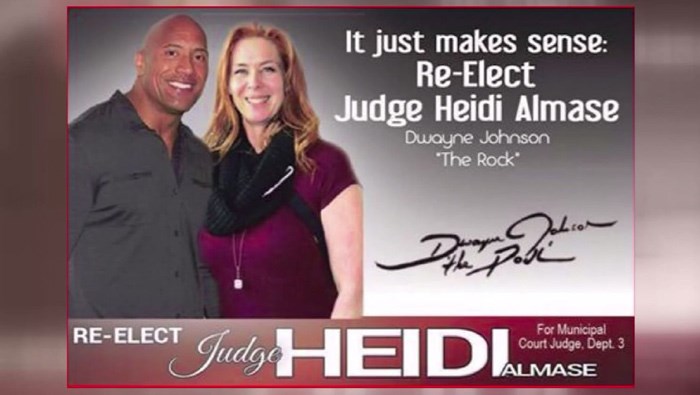
Nevada judge falsely claims celebrity endorsement in reelection campaign

Almase ad

Las Vegas judge Heidi Almase has come under criticism after a photoshopped campaign sign showed her standing with actor Dwayne “The Rock” Johnson.

Johnson has not endorsed anyone in the campaign, and in the wake of the kerfuffle Almase fired her campaign manager. No word on whether the judge will face an ethics investigation.


Justice Breyer: Courtroom cameras are too risky

Speaking at the American Constitution Society’s annual convention, Justice Stephen Breyer again expressed skepticism about video recording the Court’s oral arguments.  Breyer stated that some of his friends have told him he does “ridiculous things” during argument, and that the presence of cameras could change the tone of the session.

I will leave an assessment of a public figure questioning public access to issues of public importance, all while speaking at a quasi-public event, as an exercise for the reader.

Why do we care about the net worth of Supreme Court Justices?

Late last week, the Administrative Office of the U.S. Courts released the annual financial disclosure reports for the Justices of the Supreme Court. It turns out that the members of the Court are wealthy, with most being millionaires several times over. This is unsurprising. Indeed, it would have been shocking if the Justices — all of whom are Ivy League graduates who enjoyed successful careers before joining the Court, and many of whom are in the late stages of their working life — had not amassed considerable wealth. Yet the news spurred a wide range of stories in the mainstream media and in the blogosphere.

Yes, they’re rich.  Why do we care?

Continue reading “Why do we care about the net worth of Supreme Court Justices?”

More on Brooklyn’s independent judicial candidates

I reported earlier on a group of judicial candidates in Brooklyn who are running outside–really against–the city’s Democratic machine politics.  The candidates are all Democrats, to be sure, but they are seeking office without the blessing of the Democratic establishment.

The Brooklyn Daily Eagle now has more extended profiles on some of the candidates, including their vocal leader, John O’Hara.  Should be an interesting, and possibly ugly, campaign.


A fine example of courts and community groups working together

The Denver Post has a great story on the successes of a problem-solving court in Eagle, Colorado. The court was created seven years ago by a state judge, working in tandem with the local Masonic Lodge, to provide a new approach to individuals facing drug and alcohol addiction. Rather than jail time, first-time drug and alcohol offenders are given a chance to work toward sobriety. The expectations are high, but offenders who choose that route are supported throughout the program, and the Masons provide scholarships to some program graduates to facilitate vocational and professional training. While not everyone makes it through the program, those who do are better off in immeasurable ways.

State courts across the country have recognized over the last two decades that not all legal infractions are best resolved through traditional criminal justice. This is a nod to reality, not leniency — and it is a nice example of the courts reinventing themselves (in part) to best serve the needs of their constituencies.

The cascade effects of federal judicial nominations

Today, the Senate Judiciary Committee will consider a number of President Trump’s judicial nominees, including current Idaho state judge David Nye. In related news, the President has nominated Colorado Supreme Court Justice Allison Eid to the Tenth Circuit seat previously held by Neil Gorsuch.

Assuming that Nye and Eid are eventually confirmed by the Senate, their current state seats will become open, and will be filled by their respective state governors from a list provided by a nominating commission. (One interesting twist is that Colorado Governor John Hickenlooper, a Democrat, would be given his fourth appointment to the state supreme court, replacing a more conservative justice with presumably a more liberal one.)

The new judges in Colorado and Idaho will both serve a short, interim term before facing the voters. But the way in which they will face the voters is quite different, and highlights challenges that some states face in attracting qualified candidates for the state bench.

Continue reading “The cascade effects of federal judicial nominations”