
Federal Advisory Committee considers impact of AI on evidentiary rules

The federal Advisory Committee on Evidence Rules has begun a very preliminary conversation on how artificial intelligence will impact the reliability and authentication of evidence. The committee met with experts in April and has just begun considering whether new rules will be needed to address AI-related concerns. Among the more prominent issues are (1) how to address allegations that proferred evidence is an AI-generated “deepfake” and (2) what the proper test should be for validating mechine learning outputs.

A good summary of the committee’s progress can be found here. The full minutes of their discussion can be found here (starting at page 108). 

This is somewhat reminiscent of the work of a parallel federal court committee, the Advisory Committee on Civil Rules, to address the discovery of electronically stored information (ESI) two decades ago. That committee eventually landed on a package of amendments designed to address the unique chellanges of producing ESI in civil discovery. But it was not an easy road: by the time the new rules went into effect in 2006, individual judges had starting crafting their own approaches to deal with the cases already in front of them. And just a few years later, the technological landscape had changed sufficiently that additional amendments were needed. One should therefore expect the Advisory Committee on Evidence Rules to proceed cautiously, even as AI’s transformation of the social and business landscape proceeds apace.
New research on the internal dynamics of court rulemaking

Amending a Federal Rule of Civil Procedure is an act of intricate teamwork. Finally, some evidence of just how intricate.

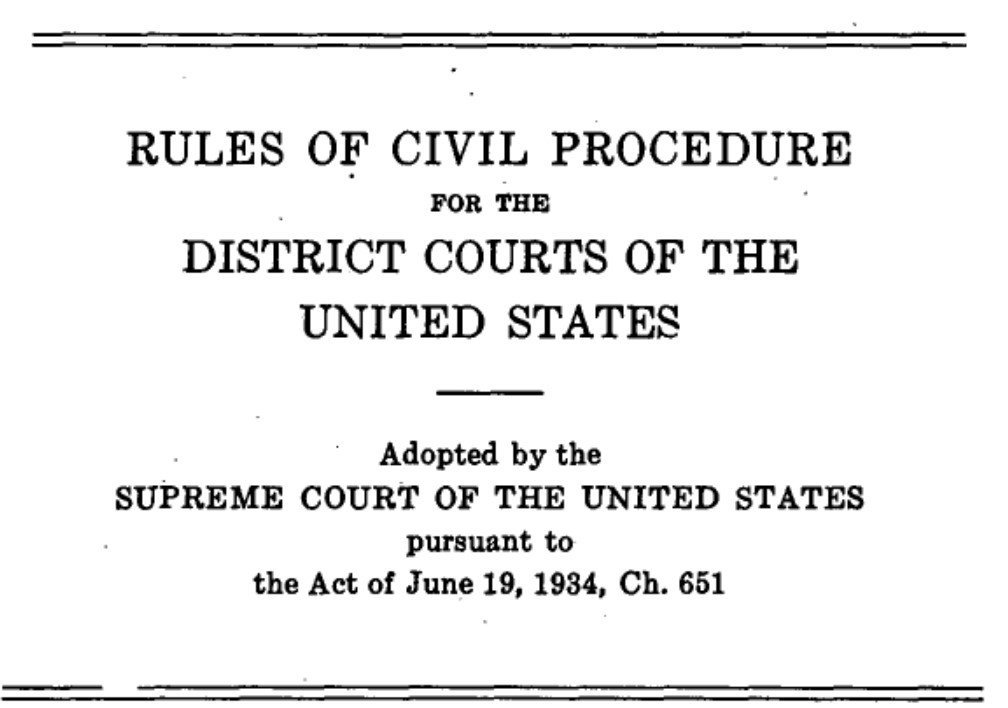
Since 1934, the federal court system has been empowered to craft its own rules of procedure and evidence. That work is primarily done by five Advisory Committees, each composed of judges, attorneys, and law professors, who review the existing rules and periodically make recommendations to amend or update them.

FRCPNo rule proposal makes everyone happy, and academics in particular often critique the rule changes that the Committees take up (or fail to take up). But in recent years, that criticism has shifted from the substance of the Committees’ work to the composition of the Committees themselves. In particular, academic critics are increasingly content to assert, without any rigorous evidence, that the makeup of the Committees leaves them prone to engage in groupthink or other cognitive biases.

Are those allegations supported by a careful review of the Committees’ work? A rigorous, four-year case study says no. In fact, far from being entities mired in groupthink, the Committees are more akin to expert teams whose decisions are carefully researched and thoroughly considered.

Continue reading “New research on the internal dynamics of court rulemaking”

In Memoriam: Craig Shaffer

I was deeply saddened by the passing last month of Craig Shaffer, U.S. Magistrate Judge for the District of Colorado. Judge Shaffer was a kind, brilliant, thoughtful, and highly respected judge. He authored a number of seminal decisions during his tenure on the federal bench, including an early, important opinion on the discovery of electronically stored information. He was also deeply committed to improving the justice system behind the scenes, as a member of the federal Advisory Committee on Civil Rules, a member of the Sedona Conference, and a frequent author on legal matters.

Judge Shaffer was also a lovely person, generous with his time and ideas. I consulted him from time to time about my own ideas on the discovery and rulemaking process, and he unfailingly offered observations that both clarified and magnified my original thoughts.

My sympathies to Judge Shaffer’s family and the entire legal community. He will be sorely missed.

New research on the organizational role of court rulemaking

Flickr_-_USCapitol_-_Thurgood_Marshall_Federal_Judiciary_Building

I am delighted to announce that my new article, The Federal Courts’ Rulemaking Buffer, is now available on SSRNPlease download it early and often!

The article arose in response to two perplexing questions about the federal court system’s civil rulemaking process. First, why do the courts engage in rulemaking at all? The courts pride themselves on being highly efficient and countermajoritarian, but rulemaking is time-consuming, quasi-democratic, and policy-driven. Making rules by committee, then, seems particularly unsuited to the work of the judicial branch.

Second, why have the courts made the rulemaking process more complicated over time? Initially, the entire work of formulating and amending rules was assigned to a single committee. Today, the rulemaking process must navigate at least five levels of the court system hierarchy, with additional opportunities for public and special interest input. As a result, amending a single rule often taken three to five years.

So what gives? Why would the courts embrace a task outside of their expertise, and then make it more and more complex?

The article offers an explanation to both questions that is grounded in organizational theory. I explain that the court system initially developed the rulemaking process as a buffer, to protect its core work from the instability of its larger environment. The power to make procedural rules gives allows the court system to respond to a drop in resources, or a surge in cases, without the entire judicial process grinding to a halt. But the rulemaking process also requires external legitimacy to function, and when that legitimacy has been challenged from time to time, the courts have responded by making the process more open, complex, and transparent.

The article touches on many of themes of this blog, including the federal court system’s resource dependence, neoinstitutional theory, and the influential role of other organizations (such as executive agencies, the ABA, and Congress) in altering court-centered rulemaking over time. And it features appearances from William Howard Taft, Earl Warren, Warren Burger, Roscoe Pound, Tom Clark, and others.

The article will be formally published in the William & Mary Law Review later this year. I welcome any thoughts from readers, privately or in the comments.

Pictured: Thurgood Marshall Federal Judiciary Building