Federal Advisory Committee considers impact of AI on evidentiary rules

The federal Advisory Committee on Evidence Rules has begun a very preliminary conversation on how artificial intelligence will impact the reliability and authentication of evidence. The committee met with experts in April and has just begun considering whether new rules will be needed to address AI-related concerns. Among the more prominent issues are (1) how to address allegations that proferred evidence is an AI-generated “deepfake” and (2) what the proper test should be for validating mechine learning outputs.

A good summary of the committee’s progress can be found here. The full minutes of their discussion can be found here (starting at page 108). 

This is somewhat reminiscent of the work of a parallel federal court committee, the Advisory Committee on Civil Rules, to address the discovery of electronically stored information (ESI) two decades ago. That committee eventually landed on a package of amendments designed to address the unique chellanges of producing ESI in civil discovery. But it was not an easy road: by the time the new rules went into effect in 2006, individual judges had starting crafting their own approaches to deal with the cases already in front of them. And just a few years later, the technological landscape had changed sufficiently that additional amendments were needed. One should therefore expect the Advisory Committee on Evidence Rules to proceed cautiously, even as AI’s transformation of the social and business landscape proceeds apace.

Federal docket data wants to be free

Over the years, there has been no shortage of workarounds for the federal courts’ PACER system, whose fee structure has been widely criticized and even engendered a lawsuit. Here is another workaround, an extensive database of case dockets going back to 2013, compiled by a Newsweek investigative reporter and posted on the Internet Archive.

(h/t Center for Data Innovation.)

More federal judges on the way?

The Senate Judiciary Committee has advanced S.4199, a bill that would create 63 new authorized judgeships for the federal district courts. Thirty-one new judgeships would be created effective January 2025, with the rest going into effect in 2029. If it passes the full Senate and the House, it would represent the first comprehensive judgeship legislation since 1990.

This is a big deal. The Judicial Conference of the United States has warned about the mismatch between judicial resources and the federal courts’ growing docket for years, and just last year recommended 66 new district judgeships to keep up with demand. In the past, similar requests have been ignored, often because neither political party was willing to give the other the chance to fill a large number of judicial vacancies.

Our present political divide, however, seems to have provided a unique opportunity. With both parties confident that they will win the Presidency in 2025, it seems a reasonable gamble to authorize the judgeships now. And indeed, the bill passed the Judiciary Committee with bipartisan support. We’ll see if it maintains traction going forward.

Televising the Trump trials

Last week, a number of Congressional Democrats wrote a letter requesting that the Judicial Conference of the United States make an exception from its longstanding policy of not televising federal criminal trials. The reason for the exception: the defendant is one Donald Trump, and Americans have a right to see the criminal proceedings against him in their full glory.

I spoke to several media outlets (including the Washington Post and NPR) about the prospect of a televised trial. A few additional thoughts follow. Continue reading “Televising the Trump trials”

Federal courts contemplate simulating cybersecurity breach

The Administrative Office of the U.S. Courts is soliciting entities which can help run a simulated cybersecurity breach. The goal is to “identify levels of risk that may not be immediately apparent.” A sensible strategy, given the importance of security within the court system and its own historic vulnerability to attack.

Judges speak out about growing threats of violence. Should they be able to arm themselves more easily?

This week, members of the Idaho Supreme Court issued a statement claiming that they, their families, and their employees have been targeted with threats and harrassment: “when disagreement becomes personal, to the point of threats against personal safety and security … a line has been crossed.” Threats of violence are now commonplace for many state and federal judges. And all too frequently, real violence erupts with tragic consequences.

Congress passed legislation last year that would increase security for federal judges. And now a Republican legislator is proposing a bill that would make it easier for federal judges to arm themselves on their way in and out of the courthouse.

It’s a difficult policy question as to whether the security of judges and their families is enhanced by easing their own access to firearms. But plainly more needs to be done to build confidence that those in the judiciary are safe from threats of violence and harassment simply for doing their jobs.

New research on the internal dynamics of court rulemaking

Amending a Federal Rule of Civil Procedure is an act of intricate teamwork. Finally, some evidence of just how intricate.

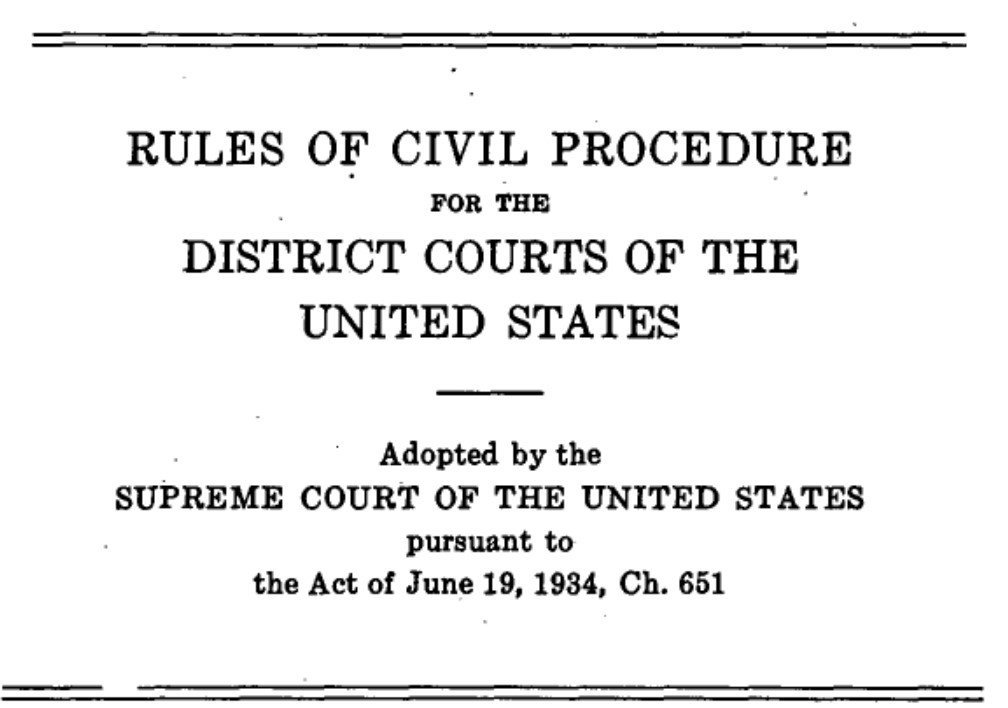
Since 1934, the federal court system has been empowered to craft its own rules of procedure and evidence. That work is primarily done by five Advisory Committees, each composed of judges, attorneys, and law professors, who review the existing rules and periodically make recommendations to amend or update them.

FRCPNo rule proposal makes everyone happy, and academics in particular often critique the rule changes that the Committees take up (or fail to take up). But in recent years, that criticism has shifted from the substance of the Committees’ work to the composition of the Committees themselves. In particular, academic critics are increasingly content to assert, without any rigorous evidence, that the makeup of the Committees leaves them prone to engage in groupthink or other cognitive biases.

Are those allegations supported by a careful review of the Committees’ work? A rigorous, four-year case study says no. In fact, far from being entities mired in groupthink, the Committees are more akin to expert teams whose decisions are carefully researched and thoroughly considered.

Continue reading “New research on the internal dynamics of court rulemaking”

First Circuit rejects state judge’s criminal appeal as premature

The First Circuit Court of Appeals has rejected an appeal by Massachusetts state judge Shelley Joseph, claiming that it is premature. Readers will recall that in 2019, Judge Joseph was charged in federal court with obstruction of justice, after she allegedly helped an illegal immigrant avoid an ICE agent who was waiting in her courtroom to arrest him.

In federal district court, Joseph moved the dismiss the charges on the grounds of “absolute judicial immunity.” The district judge declined to dismiss, and Joseph appealed. But the First Circuit held that the appeal was premature because the trial court’s ruling did not operate as a final decision on the merits.

Interlocutory appeals — those taken up before the substance of a case is decided — are rarely granted, and there is no particular reason why this case should be an exception. As the First Circuit noted, even if Joseph can invoke judicial immunity as a defense, such immunity “does not provide a right not to be tried.” The case will return to the district court for further proceedings.

Judge, Jury, and … Defendant?

A former public defender sued the federal judiciary’s lead administrative institutions for mishandling a harassment claim. Can those same institutions select the judges who hear the case?

Next week, the Fourth Circuit Court of Appeals is scheduled to hear argument in Roe v. United States, a case involving allegations that federal court officials — including those in the Administrative Office of the U.S. Courts (AO) — mishandled a workplace harassment claim. But none of the judges hearing the Fourth Circuit appeal are actually from the Fourth Circuit, just as the judge who heard the original case in the Western District of North Carolina was not from that district. Nearly two years ago, Chief Justice John Roberts reassigned the case to a district judge in Massachusetts and a “Fourth Circuit” panel composed of judges from other circuits.

From the courts’ perspective, this reassignment of the case was ordinary and ministerial, a way of avoiding the appearance of partiality or bias by taking the case away from judges in the district and circuit where the key events took place. But the plaintiff, whose case was eventually  dismissed, suggests that the process of reassignment was itself so flawed as to create “blatant conflicts of interest” and a “severe appearance of impropriety.” Accordingly, she is seeking to vacate the judgment of dismissal. 

The controversial reassignment process involved the Chief Justice, the Judicial Conference Intercircuit Assignment Committee, and staff from the AO and the Fourth Circuit. The judiciary’s brief recounts that a Fourth Circuit staffer informed an AO staffer about about the need for an intercircuit assignment — both for the district court and appellate proceedings. The AO staffer then consulted a roster of judges who had previously indicated their willingness and availability to serve on panels in cases in which one or more judges had been recused. The AO staffer then contacted each of the judges to confirm availability and willingness to serve on the case. Once the judges were confirmed, the staffer notified the Chair of the Intercircuit Assignment Committee, who finalized the necessary administrative paperwork for the Chief Justice’s signature.

The court system (represented, interestingly enough, by the Department of Justice) repeatedly characterizes this process as “routine,” noting that none of the individuals involved in the reassignment had any stake in the outcome of the case. Still, the plaintiff is unsatisfied. Although she does not claim that any of the reassigned judges are actually biased against her, the mere fact that individuals from the Judicial Conference and AO were involved in their selection is a glaring red flag. As plaintiff’s brief puts it, “[w]here following a routine process would create a conflict of interest in a particular case, the routine is supposed to yield–through proper recusal–in order to avoid the conflict of interest.”

This is a matter of substantial organizational complexity. Taken at face value, the plaintiff’s position suggests that any lawsuit naming the Judicial Conference or AO as a party would necessarily invalidate any reassignment, unless a completely different administrative apparatus is tasked with that responsibility. That could be accomplished only with considerable inefficiency. Even if the AO were to hand over its files on available judges to another office within the federal court system so as to wash its hands of the decision, the files themselves might arguably be tainted by having come from the AO. And, of course, the mechanism for selecting new judges would be placed into the hands of individuals and institutions who are not readily equipped to perform that function. 

Unfortunately, the plaintiff does not offer any clear solutions here, other than blanket vacatur of the lower court decision. That is her right, and perhaps it is good strategy. But it is hard to see how the current panel would simply throw the reassignment process into disarray without some idea of how the challenge could be met in the future.

CBO puts $43 million price tag on federal courtroom cameras

The Congressional Budget Office (CBO) has issued its estimate of the cost for implementing S. 818, the Sunshine in the Courtroom Act of 2021. That bill would authorize federal judges to record and broadcast court proceedings as long as doing so would not violate the parties’ due process rights. The authorization would last for three years.

Recognizing that the vast majority of federal judges would likely decline the bill’s invitation to record proceedings, the CBO estimates that only 10% of courtrooms nationwide (about 200 courtrooms total) would be fitted with modern video equipment. Still, the CBO expects that it will cost about $75,000 to set up each courtroom, and another $50,000 annually to administer the program. In all, a rough estimate of $43 million would have to be expended between now and 2026, when the program would automatically sunset.

Forty-three million dollars is a staggering number to most people, especially since ordinary video recording technology is now relatively cheap and accessible. To be sure, there are security and privacy issues, but wow, that’s a lot of money for a program that doesn’t even have staying power.*

* Of course, the federal government once spent $100 million on unused plane tickets in a six-year stretch, so your perceptions may vary.