
Former Alabama Chief Justice Sue Bell Cobb throws her hat into Governor’s race

Sue Bell Cobb, who served as Chief Justice of Alabama from 2007 to 2011, announced last week that she is running for Governor of the state.  She becomes the second Alabama Chief Justice in as many months to seek an elected position in another branch.

Cobb has considerable campaign experience from her days on the judiciary.  In 2006, she was involved in the most expensive judicial race in the nation, spending more than $2.6 million to win the Chief Justiceship.  Since leaving the court, she has spoken out against money in judicial politics, although not against judicial elections themselves.

Two additional observations.  First, Cobb appears to be a deeply religious woman, and her announcement and website are rife with religious themes.  Those same themes came through during her 2006 judicial campaign.

Second, Cobb had this to say about her retirement from the court system in 2011: “My chief obligation as the top administrator of the court system was to secure adequate funding from the legislature for the judiciary. I became very concerned that, because of the partisanship within the legislature, I would be unable to succeed in that most important responsibility.”

It will be interesting to see if, and how, these themes manifest themselves in the upcoming gubernatorial race.
Major controversy brews over judicial appointment in Ireland

A significant political controversy appears to be brewing in Ireland after the outgoing Taoiseach (prime minister), appointed Attorney General Maire Whelan to a seat on the country’s second highest court. Minority parties in the government, including Fianna Fail and Sinn Fein, have charged that the appointment violated established procedures. It also appears that Whelan never sought the post.

Continue reading “Major controversy brews over judicial appointment in Ireland”

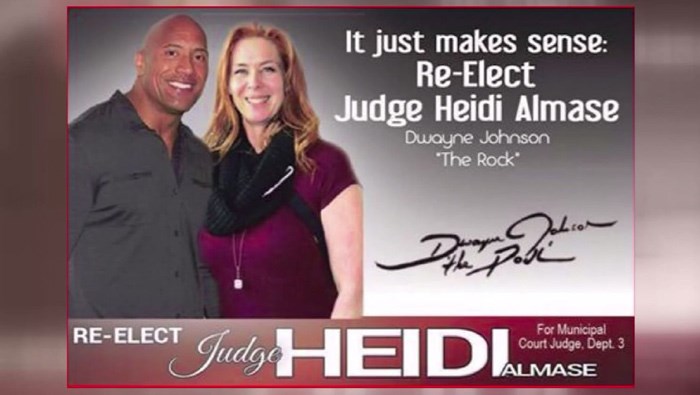
Nevada judge falsely claims celebrity endorsement in reelection campaign

Almase ad

Las Vegas judge Heidi Almase has come under criticism after a photoshopped campaign sign showed her standing with actor Dwayne “The Rock” Johnson.

Johnson has not endorsed anyone in the campaign, and in the wake of the kerfuffle Almase fired her campaign manager. No word on whether the judge will face an ethics investigation.


More on Brooklyn’s independent judicial candidates

I reported earlier on a group of judicial candidates in Brooklyn who are running outside–really against–the city’s Democratic machine politics.  The candidates are all Democrats, to be sure, but they are seeking office without the blessing of the Democratic establishment.

The Brooklyn Daily Eagle now has more extended profiles on some of the candidates, including their vocal leader, John O’Hara.  Should be an interesting, and possibly ugly, campaign.


The cascade effects of federal judicial nominations

Today, the Senate Judiciary Committee will consider a number of President Trump’s judicial nominees, including current Idaho state judge David Nye. In related news, the President has nominated Colorado Supreme Court Justice Allison Eid to the Tenth Circuit seat previously held by Neil Gorsuch.

Assuming that Nye and Eid are eventually confirmed by the Senate, their current state seats will become open, and will be filled by their respective state governors from a list provided by a nominating commission. (One interesting twist is that Colorado Governor John Hickenlooper, a Democrat, would be given his fourth appointment to the state supreme court, replacing a more conservative justice with presumably a more liberal one.)

The new judges in Colorado and Idaho will both serve a short, interim term before facing the voters. But the way in which they will face the voters is quite different, and highlights challenges that some states face in attracting qualified candidates for the state bench.

Continue reading “The cascade effects of federal judicial nominations”

Another voice against de facto party control over the New York courts

In light of several recent kerfuffles involving Manhattan judge Joan Kenney, the New York Post has run a lengthy piece explaining the deep flaws in the de facto Democratic Party control over the selection of New York City judges. The piece’s criticisms are spot on, and would be regardless of which party held control.

The standard disclaimer applies: a lousy selection system can still produce some excellent judges. And there are doubtless many excellent judges in the New York State system. But why New Yorkers would prefer a system that greatly increases the likelihood of unqualified, politically connected judges is beyond me.

Five former Pennsylvania governors renew push for merit selection

Former governors Dick Thornburgh, Tom Ridge, Mark Schweiker, Ed Rendell, and Tom Corbett have published an op-ed in the Philadelphia Inquirer, calling for the merit selection of all judges in the Keystone State.  Their position goes beyond even the current proposed legislation, which would extend merit selection only to the state’s appellate judges. The governors note:

Merit selection is not a panacea. We are hardly naïve about today’s political realities. Nonetheless, having in place a system by which any qualified candidate can apply for an open seat on the appellate bench and be considered by a bipartisan, diverse group of citizens from across the commonwealth — a group tasked with evaluating the strength of that candidate’s professional and personal qualifications to serve — is a far better system than one in which random ballot position, fund-raising, and campaigning are determining factors.

The op-ed also cites to the excellent work being done by Pennsylvanians for Modern Courts to make the case for changing the state’s judicial selection system.

Pennsylvania legislators push for merit selection of state judges

State Representatives Bryan Cutler and Madeleine Dean have proposed an amendment to the Pennsylvania  constitution that would eliminate direct elections for state appellate judges.  Instead, judges would be chosen by merit selection.  Under the plan, a 13-member panel would choose five nominees for a judicial vacancy, and send that list to the governor. The governor would then select one of the five nominees, and the state senate would confirm the final selection.  Judges would then face periodic retention elections.  The proposal mirrors many of the best qualities of existing merit selection systems.

Similar bills have been proposed in the past (including many by Rep. Cutler), without much success.  But you can’t move the needle if you don’t keep trying, and Pennsylvania’s direct elections of judges have not been anything to write home about.  Good luck to the proponents this time around.

Lawyer cleared of voter fraud conviction seeks judgeship in Brooklyn

John O’Hara’s 1997 voter fraud conviction–for allegedly casting a ballot in the wrong district–was overturned just a few months ago.  O’Hara is now seeking to take on Brooklyn’s Democratic machine:

O’Hara’s slate for the Democratic primary in September includes himself and five other candidates, as part of what he is calling a “rage against the machine” to challenge the Brooklyn Democratic Party’s status quo of choosing who gets the gavel.

The party’s Judicial Screening Committee nominates a candidate through the screening process and then backs them — but the process is far from independent, and O’Hara’s slate of six is looking to take on the machine, he said.

“Because the whole so-called independent judicial screening panel is not very independent. We have nothing to do with that,” he said. “Machine-backed candidates, those are the people we are running against. We are all independent candidates.”

North Carolina Court of Appeals update

Last month I reported on a fast-moving battle between North Carolina’s Republican legislature and Democratic governor over the state’s Court of Appeals. The legislature proposed a bill to shrink the size of the court in order to deny the governor additional appointments.  In response, a court of appeals judge took early retirement so that the governor could make an interim appointment before the bill was passed. Literally fifteen minutes later, the governor appointed John Arrowood, a former judge who had lost his seat in a previous election, to the Court of Appeals for a second time.

Now it appears that the saga will continue for the next two years.  Andrew Heath, a trial judge appointed last December by the previous governor, has announced that he will challenge Judge Arrowood for his seat in the 2018 election.  Stay tuned.