Nevada judge falsely claims celebrity endorsement in reelection campaign

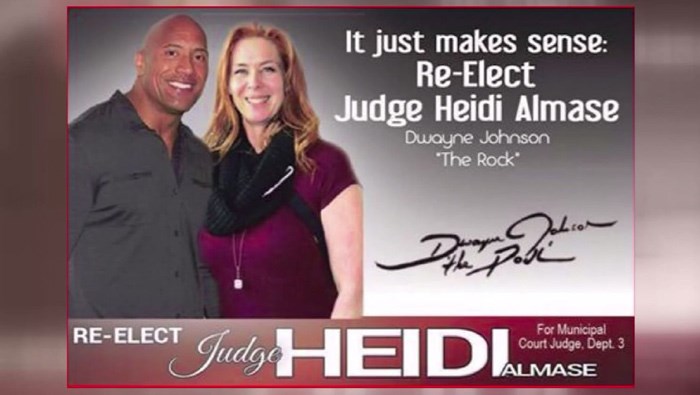
Almase ad

Las Vegas judge Heidi Almase has come under criticism after a photoshopped campaign sign showed her standing with actor Dwayne “The Rock” Johnson.

Johnson has not endorsed anyone in the campaign, and in the wake of the kerfuffle Almase fired her campaign manager. No word on whether the judge will face an ethics investigation.


More on Brooklyn’s independent judicial candidates

I reported earlier on a group of judicial candidates in Brooklyn who are running outside–really against–the city’s Democratic machine politics.  The candidates are all Democrats, to be sure, but they are seeking office without the blessing of the Democratic establishment.

The Brooklyn Daily Eagle now has more extended profiles on some of the candidates, including their vocal leader, John O’Hara.  Should be an interesting, and possibly ugly, campaign.


A fine example of courts and community groups working together

The Denver Post has a great story on the successes of a problem-solving court in Eagle, Colorado. The court was created seven years ago by a state judge, working in tandem with the local Masonic Lodge, to provide a new approach to individuals facing drug and alcohol addiction. Rather than jail time, first-time drug and alcohol offenders are given a chance to work toward sobriety. The expectations are high, but offenders who choose that route are supported throughout the program, and the Masons provide scholarships to some program graduates to facilitate vocational and professional training. While not everyone makes it through the program, those who do are better off in immeasurable ways.

State courts across the country have recognized over the last two decades that not all legal infractions are best resolved through traditional criminal justice. This is a nod to reality, not leniency — and it is a nice example of the courts reinventing themselves (in part) to best serve the needs of their constituencies.

The cascade effects of federal judicial nominations

Today, the Senate Judiciary Committee will consider a number of President Trump’s judicial nominees, including current Idaho state judge David Nye. In related news, the President has nominated Colorado Supreme Court Justice Allison Eid to the Tenth Circuit seat previously held by Neil Gorsuch.

Assuming that Nye and Eid are eventually confirmed by the Senate, their current state seats will become open, and will be filled by their respective state governors from a list provided by a nominating commission. (One interesting twist is that Colorado Governor John Hickenlooper, a Democrat, would be given his fourth appointment to the state supreme court, replacing a more conservative justice with presumably a more liberal one.)

The new judges in Colorado and Idaho will both serve a short, interim term before facing the voters. But the way in which they will face the voters is quite different, and highlights challenges that some states face in attracting qualified candidates for the state bench.

Continue reading “The cascade effects of federal judicial nominations”

Another voice against de facto party control over the New York courts

In light of several recent kerfuffles involving Manhattan judge Joan Kenney, the New York Post has run a lengthy piece explaining the deep flaws in the de facto Democratic Party control over the selection of New York City judges. The piece’s criticisms are spot on, and would be regardless of which party held control.

The standard disclaimer applies: a lousy selection system can still produce some excellent judges. And there are doubtless many excellent judges in the New York State system. But why New Yorkers would prefer a system that greatly increases the likelihood of unqualified, politically connected judges is beyond me.

Makar on raising the mandatory retirement age for state judges

The Honorable Scott Makar (First District Court of Appeal, Florida) has written a short and interesting article suggesting that Florida’s mandatory judicial retirement age should be raised from 70 to at least 73. The article revisits arguments that he made twenty years ago, and finds that those arguments are still well-supported. Among the factors supporting raising the retirement age:

  • Judging is a “late peak, sustained activity” where performance peaks later in life;
  • The average American life expectancy at birth is now nearly 79 years, more than eight years higher than when the current retirement age was adopted in 1972;
  • Technology helps older judges continue to do their jobs efficiently;
  • Florida’s demographics are consistent with older citizens working later into their lives; and
  • The current constitutional provision contains a loophole that allows some judges to stay on the bench until age 73 anyway.

The judge for whom I clerked recently left the bench due to Colorado’s mandatory retirement age, and he is as sharp, fair, and thoughtful as ever. There may be good arguments against life tenure for judges, bur forcing years of accumulated experience, wisdom, and intellectual capital off the bench simply because a particular birthday rolls around seems utterly self-defeating.

(Link may require a subscription.)

Citation: Scott D. Makar, A Modest Proposal: Raise the Mandatory Judicial Retirement Age, 18 Fla. Coast. L. Rev. 51 (2016).

 

Five former Pennsylvania governors renew push for merit selection

Former governors Dick Thornburgh, Tom Ridge, Mark Schweiker, Ed Rendell, and Tom Corbett have published an op-ed in the Philadelphia Inquirer, calling for the merit selection of all judges in the Keystone State.  Their position goes beyond even the current proposed legislation, which would extend merit selection only to the state’s appellate judges. The governors note:

Merit selection is not a panacea. We are hardly naïve about today’s political realities. Nonetheless, having in place a system by which any qualified candidate can apply for an open seat on the appellate bench and be considered by a bipartisan, diverse group of citizens from across the commonwealth — a group tasked with evaluating the strength of that candidate’s professional and personal qualifications to serve — is a far better system than one in which random ballot position, fund-raising, and campaigning are determining factors.

The op-ed also cites to the excellent work being done by Pennsylvanians for Modern Courts to make the case for changing the state’s judicial selection system.

Minnesota adds two judgeships to keep up with case filings

Just yesterday I noted the impact of increased case filings on state courts in Washington.  The State of Minnesota has also recently experienced significant increases in filings, especially in major criminal cases and child protection cases.  In response, the Minnesota legislature has authorized two new judgeships to help alleviate the burden.

The courts helped themselves in this instance by keeping careful statistics on caseload growth, which added meaningful support to their request for new judges.

Pennsylvania legislators push for merit selection of state judges

State Representatives Bryan Cutler and Madeleine Dean have proposed an amendment to the Pennsylvania  constitution that would eliminate direct elections for state appellate judges.  Instead, judges would be chosen by merit selection.  Under the plan, a 13-member panel would choose five nominees for a judicial vacancy, and send that list to the governor. The governor would then select one of the five nominees, and the state senate would confirm the final selection.  Judges would then face periodic retention elections.  The proposal mirrors many of the best qualities of existing merit selection systems.

Similar bills have been proposed in the past (including many by Rep. Cutler), without much success.  But you can’t move the needle if you don’t keep trying, and Pennsylvania’s direct elections of judges have not been anything to write home about.  Good luck to the proponents this time around.

Washington court faces 300 percent increase in case filings after city implements red light cameras

In another example of external decisions directly affecting internal court operations, the state courts located in Des Moines, Washington reported a 300 percent increase in case filings after the city implemented red light cameras.

The impact of the cameras was “much greater than we anticipated,” [Judge Lisa Leone] told [the city] Council.

The judge said she was “so impressed with every single” member of her staff.

“Just today (May 11) there was a line out the door … every clerk was on the phone taking the time for every one who has questions about the cameras or anything else.”