
Biden tips his hand on the next Supreme Court nominee

Keep an eye on Judge Ketanji Brown Jackson, the newest nominee to the D.C. Circuit.
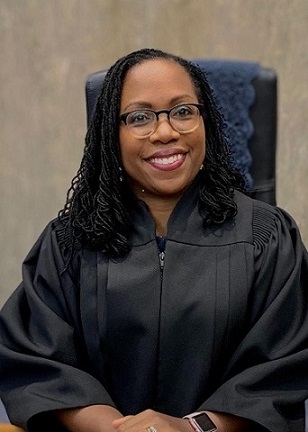
Ketanji Brown JacksonPresident Biden has issued his first list of intended judicial nominees, mostly to federal district courts across the country. They are a highly accomplished and — as best I can tell — highly qualified group of nominees. 

Perusing the list, I’m going to call my shot now and predict that whenever an opening on the Supreme Court occurs, the  President’s first nominee will be Judge Ketanji Brown Jackson. Judge Jackson is already a well-respected federal district judge, and is set to be nominated to the U.S. Court of Appeals for the D.C. Circuit. She therefore follows the path of other budding judicial stars who were elevated to the circuit courts before an eventual Supreme Court nomination by the same president. (Justice Amy Coney Barrett is the most recent example.) Judge Jackson also checks all the boxes: she is brilliant, accomplished, hard-working, well-respected, relatively young, and (important for Biden’s camp, at least) a Black woman. She is also kind, professional, and gracious — at least that is the clear memory I have from the time we overlapped as litigation associates at Goodwin Procter nearly twenty years ago.

Predictably, much of the mainstream media is focusing on the race and gender of the nominees, rather than their exceptional talent and qualifications. This does a remarkable disservice both to the nominees and the public. It reduces a lifetime of individual hard work, achievement — and yes, most assuredly some luck — to a crass demographic calculation. And it communicates that their skills and abilities are secondary to their immutable characteristics, a message that can only reduce confidence in judicial decisions and the court system as a whole.  

Congratulations to all the nominees. The country will better off with your skill and talent filling our open judgeships.

Portland’s federal courthouse attacked again

The Mark O. Hatfield United States Courthouse in Portland, Oregon, which sustained significant damage in last summer’s Antifa riots, was attacked again over the weekend — just three days after federal officials removed the non-scalable fencing that had surrounded the courthouse since August. (The fencing has since returned.)

As shown in the video directly below, vandals broke courthouse windows and covered the building with obscene graffiti.


The Oregonian has a powerful article chronicling the damage, not only the the physical building but also to the public psyche.

Among the graffiti left on the front of the courthouse was a message that said in red, “NAZI’S WORK HERE.”

“As a first generation American whose parents lived through the horrors of World War II, in England and in Norway, you can’t say anything more offensive than alleging that the people who work inside that building, who I know and love, are Nazis,” Acting U.S. Attorney Scott Asphaug said Sunday.

“That building represents justice,” he said. “This is where people come to have their civil rights heard.”

The staff, attorneys and judges have continued to conduct courthouse operations throughout the past year’s mass protests, and will continue to do so undeterred, Asphaug said. Asphaug said he supports the rights of people to protest and make their voices heard but doesn’t support riotous behavior and the damage to the courthouse.

“The people who work in that building are a lot stronger than graffiti and broken windows,” he said, “and they’ll continue to do the important work they do.”

Anerican institutions may be imperfect, but they are grounded in time-honored truths about the value of liberty, opportunity, and equality. Their assailants, by contrast, are little more than common thugs and intellectual frauds.

State courts come under legislative assault

State legislators are trying to politicize their judiciaries for short-term gain. Courts, their users, and the public must speak up to stop them.

The first weeks of the 2021 legislative session have seen an extraordinary number of proposals to overhaul the selection of judges or otherwise affect the composition of state judiciaries. Among them:

In Montana, Senate Bill 140 would eliminate the state’s judicial nominating commission, giving the governor direct appointment power over district court judges and state supreme court justices. The nominating commission, in place for nearly half a century, was expressly implemented to depoliticize the judicial appointment process. Despite an outpouring of criticism for the proposal, which is widely seen as a partisan gambit by new Governor Greg Gianforte and Republican legislators, the bill passed the legislature last week. If signed by the governor, the bill would make Montana a national outlier in its refusal to use an independent nominating commission.

In Alaska, a very similar bill would eliminate the role of the state’s nominating commission for the appointment of judges on the district courts and state court of appeals. Senate Bill 14 was introduced by Republican senator Mike Shower in late January. As in Montana, the bill has been panned as “a concerted strategy to dismantle Alaska’s system of selecting judges based on merit and replace it with a process that relies primarily on politics.” Alaska’s Chief Justice, Joel Bolger, similarly criticized the bill as undermining a well-established and respected judicial selection process. Continue reading “State courts come under legislative assault”

Are Supreme Court amicus briefs posing a transparency problem?

That’s the question raised in this excellent Wall Street Journal piece by Jess Bravin. He reports that the number of amicus briefs filed with the Supreme Court has risen dramatically in recent years, with many of the briefs coming from opaque interest groups. Current Supreme Court rules only require that an amicus brief disclose whether a party or its lawyer funded the brief, or whether anyone else outside the named party contributed to its preparation. But this leaves plenty of room for little-known groups to file briefs, which may carry outsized influence with the Court.

Senator Sheldon Whitehouse (D-RI) is pushing for greater transparency in amicus briefs. I have criticized Senator Whitehouse routinely on this blog for his often perverse behaviors toward the federal courts, but on this issue we agree: greater transparency would benefit everyone.

Still, the courts would be better off modifying the policy themselves, rather than sitting back and allowing Whitehouse and his compatriots to force a legislative solution.

A nice primer on how federal funding reaches state and local courts

Pew Charitable Trusts has a very informative interview with American University’s Karen Lash about how to leverage federal pass-through funding to improve state and local civil justice systems. It’s a useful read for anyone who wants to better understand how federal spending trickles down to local entities.

Today’s COVID responses can improve tomorrow’s judicial performance evaluations

That’s the main thrust of my latest guest post at the IAALS blog. Forced to adopt a wide range of technological resources during the pandemic, courts systems are now better situated to use that technology to improve surveys, observe judicial behavior, and communicate wih the public.

It’s our fourth blogiversary!

Thanks to all the readers who have come to The Independent Third Branch since our founding in late 2017. The start of 2021 has seen a surge  in readership and subscribers, for which I am humbled and deeply thankful.

Please look around while you’re here, subscribe for email updates, and check back regularly for more discussion of courts and the judicial process.

How will virtual trials affect the appellate process?

That’s the question posed in this excellent article from Law360. A snippet:

Lawyers who engage in virtual trials need to anticipate that eventuality and do everything they can to minimize errors that can occur because of technology, as well as preserve their objections properly and quickly during virtual proceedings, [attorney Carl] Guthrie said.

“We should always be one step ahead and prepared for what happens … if an appellate court does look at it,” he said.

Courts that have been broadcasting their proceedings usually include a warning that recording is prohibited, but those warnings aren’t always heeded. One example is the recent viral video of the lawyer who was unable to remove a cat filter and told a court, “I’m not a cat.” The video preserving that moment included in black and white font a prohibition against recording.

But more broadly, Guthrie said that in virtual proceedings, evidentiary gaffes are some of the easiest to make — and can be the most damaging. Accidentally showing exhibits to jurors before they’ve been admitted by the judge, for example, is an easily reversible error, he noted.

Virtual hearings and trials are assuredly here to stay, at least in some form, after the pandemic subsides. It’s good that lawyers and judges are getting out in front of these issues.


People are ducking jury duty amid COVID concerns

Bloomberg Law reports that while some state courts have reopened their courtrooms to live trials, most people called for jury duty are not showing up. In California Superior Court in San Diego, only 5% of those receiving a jury summons actually came to court on their appointed day.

It’s not that courthouses are inherently dangerous, or likely super-spreader locations. Indeed, courts nationwide have made every effort to insure juror safety, and — as importantly — to make jurors feel safe. Massachusetts, for example, has temporarily reduced the jury size from twelve to six, and has installed so much plexiglass in courthouses that, according to Chief Justice of the Trial Courts Paula Carey, some jurors felt safer in the courthouse than at the grocery store.

Still, this is going to be a slow climb back to normalcy. The length of the pandemic has conditioned our brains to think differently about being in enclosed areas with others, and even after we hit herd immunity, it will be a while before we can loosen up again. To keep the docket moving, courts should think about hybrid models, using both live and video components, even after the pandemic subsides.

Nevada Supreme Court seeks substantial pay hikes for state judges

The proposed legislation would increase all judicial salaries by $30,000/year, with additional automatic increases beginning in 2027. Interestingly, the bill came from the supreme court itself, as Nevada permits government entities other than the legislature to propose legislation.