
Federal judiciary warned of effects of budget shortfall

A press release from the U.S. Courts highlights concerns that Congressional inaction on the federal budget will leave the federal courts about $800 million short of what they need to operate in the coming year.

The judicial branch has requested $9.4 billion in discretionary funding for Fiscal Year 2026. (If that sounds like a lot, consider that the discretionary budget for the Department of the Interior alone was nearly double that amount for FY2025, and the judiciary is an entire branch of government.) However, the requested amount is hardly assured. If Congress chooses to operate under another full-year continuing resolution for the coming year instead of passing a new budget, the courts would expect to receive only $8.6 billion, a nearly 10% shortfall in requested funds.

More limited appropriations could hurt the federal courts’ implementation of courthouse security and cybersecurity measures, IT modernization, and funding attorneys for indigent defendants. The new Fiscal Year starts October 1.
Massachusetts federal court adopts anti judge-shopping provision

Chief Judge Dennis Saylor of the U.S. District Court for the District of Massachusetts has issued an order regarding the random assignment of certain civil cases filed in the district. The order states that “any civil action seeking to bar or mandate nationwide enforcement of a federal law, including a rule, regulation, policy, or order of the executive branch or a federal agency, whether by declaratory judgment and/or any form of injunctive relief,” will be randomly assigned to one of the district’s thirteen active Article III judges.

The order matters because the vast majority of the district’s judges sit in Boston, with only one judge located in each of Springfield and Worcester. A party hoping to enjoin a federal law or regulation might be tempted to file in one of those cities in order to secure the single judge assigned there. The federal courts have increasingly resisted such efforts to “judge shop,” especially in cases where a single district judge is invited to permit or prevent the application of a federal law nationwide.

House votes to add 66 new federal judgeships; will Biden veto?

This week, the House of Representatives comfortably passed the JUDGES Act (S.4199), which would add 66 federal judgeships over the next ten years. The judgeships would be phased in over ten years, with the first two tranches coming in 2025 and 2027.

The Senate passed the same bill back in August, but House Republicans stalled a vote on the bill until after the election. Now that Donald Trump will return to the White House, the House Democrats decided that it was their turn to play politics with the judiciary and slow-played the vote until mid-December.

This is an excellent result for a resource-starved judiciary. But it appears that the drama will continue for a while, as President Biden has threatened to veto the bill on his way out the door. It’s worth unpacking the illogic and petulance of his threat.

Continue reading “House votes to add 66 new federal judgeships; will Biden veto?”

Federal docket data wants to be free

Over the years, there has been no shortage of workarounds for the federal courts’ PACER system, whose fee structure has been widely criticized and even engendered a lawsuit. Here is another workaround, an extensive database of case dockets going back to 2013, compiled by a Newsweek investigative reporter and posted on the Internet Archive.

(h/t Center for Data Innovation.)

More federal judges on the way?

The Senate Judiciary Committee has advanced S.4199, a bill that would create 63 new authorized judgeships for the federal district courts. Thirty-one new judgeships would be created effective January 2025, with the rest going into effect in 2029. If it passes the full Senate and the House, it would represent the first comprehensive judgeship legislation since 1990.

This is a big deal. The Judicial Conference of the United States has warned about the mismatch between judicial resources and the federal courts’ growing docket for years, and just last year recommended 66 new district judgeships to keep up with demand. In the past, similar requests have been ignored, often because neither political party was willing to give the other the chance to fill a large number of judicial vacancies.

Our present political divide, however, seems to have provided a unique opportunity. With both parties confident that they will win the Presidency in 2025, it seems a reasonable gamble to authorize the judgeships now. And indeed, the bill passed the Judiciary Committee with bipartisan support. We’ll see if it maintains traction going forward.

Federal courts contemplate simulating cybersecurity breach

The Administrative Office of the U.S. Courts is soliciting entities which can help run a simulated cybersecurity breach. The goal is to “identify levels of risk that may not be immediately apparent.” A sensible strategy, given the importance of security within the court system and its own historic vulnerability to attack.

Judges speak out about growing threats of violence. Should they be able to arm themselves more easily?

This week, members of the Idaho Supreme Court issued a statement claiming that they, their families, and their employees have been targeted with threats and harrassment: “when disagreement becomes personal, to the point of threats against personal safety and security … a line has been crossed.” Threats of violence are now commonplace for many state and federal judges. And all too frequently, real violence erupts with tragic consequences.

Congress passed legislation last year that would increase security for federal judges. And now a Republican legislator is proposing a bill that would make it easier for federal judges to arm themselves on their way in and out of the courthouse.

It’s a difficult policy question as to whether the security of judges and their families is enhanced by easing their own access to firearms. But plainly more needs to be done to build confidence that those in the judiciary are safe from threats of violence and harassment simply for doing their jobs.

New research on the internal dynamics of court rulemaking

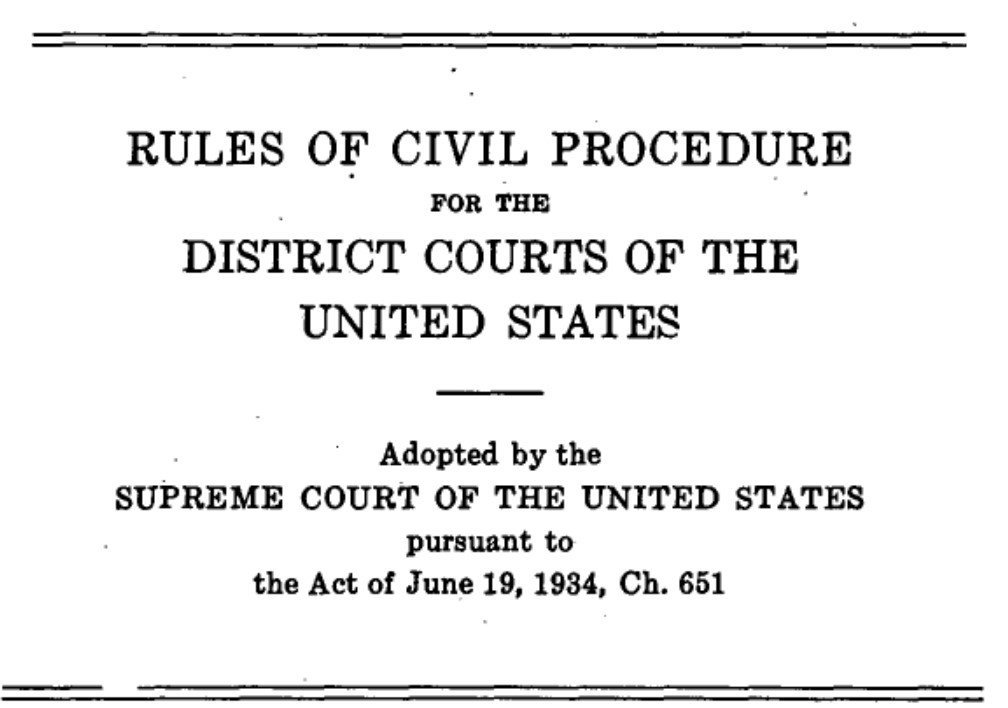
Amending a Federal Rule of Civil Procedure is an act of intricate teamwork. Finally, some evidence of just how intricate.

Since 1934, the federal court system has been empowered to craft its own rules of procedure and evidence. That work is primarily done by five Advisory Committees, each composed of judges, attorneys, and law professors, who review the existing rules and periodically make recommendations to amend or update them.

FRCPNo rule proposal makes everyone happy, and academics in particular often critique the rule changes that the Committees take up (or fail to take up). But in recent years, that criticism has shifted from the substance of the Committees’ work to the composition of the Committees themselves. In particular, academic critics are increasingly content to assert, without any rigorous evidence, that the makeup of the Committees leaves them prone to engage in groupthink or other cognitive biases.

Are those allegations supported by a careful review of the Committees’ work? A rigorous, four-year case study says no. In fact, far from being entities mired in groupthink, the Committees are more akin to expert teams whose decisions are carefully researched and thoroughly considered.

Continue reading “New research on the internal dynamics of court rulemaking”

CBO puts $43 million price tag on federal courtroom cameras

The Congressional Budget Office (CBO) has issued its estimate of the cost for implementing S. 818, the Sunshine in the Courtroom Act of 2021. That bill would authorize federal judges to record and broadcast court proceedings as long as doing so would not violate the parties’ due process rights. The authorization would last for three years.

Recognizing that the vast majority of federal judges would likely decline the bill’s invitation to record proceedings, the CBO estimates that only 10% of courtrooms nationwide (about 200 courtrooms total) would be fitted with modern video equipment. Still, the CBO expects that it will cost about $75,000 to set up each courtroom, and another $50,000 annually to administer the program. In all, a rough estimate of $43 million would have to be expended between now and 2026, when the program would automatically sunset.

Forty-three million dollars is a staggering number to most people, especially since ordinary video recording technology is now relatively cheap and accessible. To be sure, there are security and privacy issues, but wow, that’s a lot of money for a program that doesn’t even have staying power.*

* Of course, the federal government once spent $100 million on unused plane tickets in a six-year stretch, so your perceptions may vary.

Two federal bankruptcy courts move to combat forum shopping

Mayer Brown’s blog, Real Bankruptcy Intel, explains:

Following the controversy surrounding Purdue[‘s careful filing of a bankruptcy petition designed to land specifically with Judge Robert Drain], as well as a lull in filings nationwide, in November, the SDNY elected to adopt a random case assignment system. Specifically, subdivision (f) of Local Bankruptcy Rule 1073-1 now states:

    1. Mega Chapter 11 Cases. Notwithstanding subdivision (a) of this rule, the Clerk shall assign a mega chapter 11 case to a Judge in the District by random selection irrespective of the courthouse in which the case is filed. A chapter 11 case qualifies as a mega chapter 11 case if the assets or liabilities of the debtor are equal to or greater than $100 million. A multi-debtor chapter 11 case qualifies as a mega chapter 11 case if the cumulative assets or cumulative liabilities of the filing debtors are equal to or greater than $100 million.[5]

Therefore, as of December 1, cases filed in the SDNY are to be assigned on a random basis to judges irrespective of the courthouse in which they are filed. As part of this rule, any SDNY judge can preside over a case in a courthouse where he or she is not usually assigned. Chief Judge Cecelia G. Morris explained that she hopes the adoption of this system will result in a more balanced utilization of judicial resources.[6] Judge Drain himself also commented that he “supported the change unanimously.”[7] Such adaptation now places the SDNY on par with the District of Delaware—another longstanding hotspot for mega chapter 11 cases—which already had a random assignment system in place. This move is likely to prevent debtors from “judge shopping” within the district.

Within a month of the SDNY’s announcement, the Bankruptcy Court for the Eastern District of Virginia (the district that contains Richmond and Alexandria) also implemented a similar rule.[8]