Federal court: at-large voting for Louisiana judicial elections is unconstitutional

Earlier this year, I reported on a federal civil rights trial in Terrebonne Parish, Louisiana (the Baton Rouge area).  The plaintiffs alleged that the system used to elect judges in the state’s 32nd Judicial District was unconstitutional in that it disenfranchised minority voters.  In particular, plaintiffs alleged that the state’s “at-large” voting system, meaning that judges are chosen through a parish-wide vote even though each judge presides over a specific district.  The bench trial concluded at the end of April.

On Thursday, Judge Brady issued a 91-page ruling, concluding that the use of at-large voting in Terrebonne Parish unconstitutionally dilutes the voting power of black voters.  The actual remedy will be determined later through a series of conferences with parties and counsel.

The full story and reaction is here.

Brooklyn judicial candidates accuse local party chief of holding illegal fundraiser for their opponents

I have previously discussed the candidacies of five Brooklyn residents who are running for judge, but refuse to go through the selection system dominated by Democratic Party bosses. In the latest twist in the story, a spokesman for the five candidates has accused local party boss Frank Seddio of hosting a “illegal” fundraiser for the party’s preferred candidates on August 23.

Surely some of this is an effort to stay in the news cycle, but the accusations of spokesman Gary Tilzer are still damning:

Seddio, an attorney, sent the red, white and blue invite to more than 185 people — including sitting judges, judicial candidates, attorneys, developers, politicians, lobbyists and members of the Judicial Screening Committee. The invite vaguely touts fund-raising “to support our contested countywide candidates.”

It doesn’t specify the candidates who will benefit or the election that’s involved.

***

Guests were instructed to write their $500 to $5,000 checks out to the Kings County Democratic County Committee, an account that’s controlled by the Brooklyn Democratic Party, and mail them to Seddio’s home address, according to the letter.

Tilzer’s three-page letter to the committees said Seddio’s fund-raising efforts violate the Rules Governing Judicial Conduct and are unethical on seven points, including not disclosing who the event benefits, inviting sitting judges to contribute and, since the beneficiaries aren’t named, having judicial candidates raising money with potential nonjudicial candidates.

As I have noted before, those who are truly concerned about the influence of money in politics might want to start by shining a light on local hornet’s nests like these.

“Insurgent” judicial candidates in Brooklyn continue their fight against machine politics

In June, I flagged an interesting story of five judicial candidates in Brooklyn who are aggressively running against the Democratic Party machine. These candidates, led by John O’Hara (a lawyer with a colorful and checkered past), assert that the borough’s independent screening panel is really just an arm of the local Democratic Party, and subject to the wishes of party bosses. All but one of the insurgent candidates has refused to go before the panel .

With the primary about a month away, the New York Law Journal weighs in with an article that captures the essence of the insurgency, as well as the establishment position.  The crux of their claims: the party asserts that the 24-member screening panel simply determines candidates’ fitness for the bench, and expects no quid pro quo for the candidates it deems qualified. The O’Hara group alleges that the panel is essentially a mechanism for attorney members to receive future favors from the candidates they endorse.

I generally favor screening panels or nominating commissions as part of a comprehensive judicial selection process. But this challenge makes clear that if the panel itself is not seen as legitimate, neither will the judicial candidates it endorses. And New York has a long and unfortunate history of party boss control over the selection of local judges. We’ll see how it plays out at the September 12 primary.

Philadelphia Bar’s judicial recommendations make an impact with voters

The Philadelphia Bar Association has published recommendations to voters on local judicial candidates for decades. This year, for the first time, it handed out a list of recommended candidates at selected polling places attempted to measure whether those recommendations made an impact.  The news was encouraging:

The Bar Association’s presence increased the gap between recommended and not recommended Common Pleas candidates by about 0.4 percent at the 41 polling locations, a significant impact in an election where winners needed just over 4 percent of the vote. Had the Bar Association placed volunteers all over the city, only one not-recommended judge would have won, as opposed to the three that actually did.

Some important caveats: the study was geographically limited, and several candidates who were not recommended were still elected (they were all placed in the first column on ballots). Moreover, at a time in American history when distrust of expertise is so high, some portion of the public seems likely to vote against the bar’s recommendations simply because they came from attorneys. And bar recommendations are only needed because Pennsylvania continues to insist on electing its judges in the first place. But overall, this is good news. I hope the bar association can come up with the resources to expand its distribution program for the next election cycle.

Alexis de Tocqueville on American courts

“An American judge … cannot compel the people to make laws, but at least he can constrain them to be faithful to their own laws and remain in harmony with themselves.”

“I am aware of a hidden tendency in the United States leading the people to diminish judicial power; under most of the state constitutions the government can, at the request of both houses, remove a judge from office. Under some constitutions the judges are elected and subject to frequent reelection. I venture to predict that sooner or later these innovations will have dire results and that one day it will be seen that by diminishing the magistrates’ independence, not judicial power only but the democratic republic itself has been attacked.”

“I do not know whether a jury is good for litigants, but I am sure it is very good for those who have to decide the case. I regard it as one of the most effective means of popular education at society’s disposal.”

— Selected from Democracy in America (13th ed. 1850)

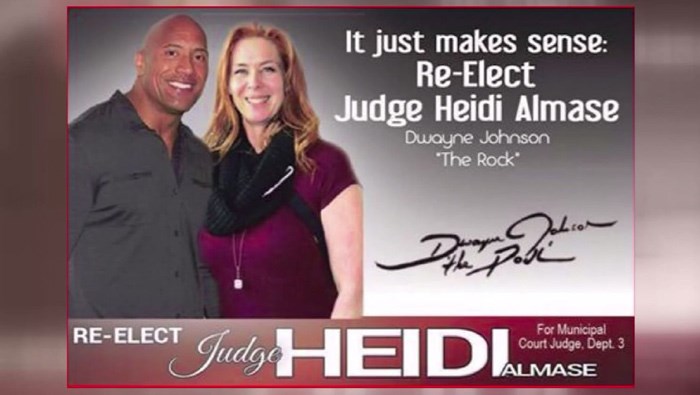
Nevada judge falsely claims celebrity endorsement in reelection campaign

Almase ad

Las Vegas judge Heidi Almase has come under criticism after a photoshopped campaign sign showed her standing with actor Dwayne “The Rock” Johnson.

Johnson has not endorsed anyone in the campaign, and in the wake of the kerfuffle Almase fired her campaign manager. No word on whether the judge will face an ethics investigation.


More on Brooklyn’s independent judicial candidates

I reported earlier on a group of judicial candidates in Brooklyn who are running outside–really against–the city’s Democratic machine politics.  The candidates are all Democrats, to be sure, but they are seeking office without the blessing of the Democratic establishment.

The Brooklyn Daily Eagle now has more extended profiles on some of the candidates, including their vocal leader, John O’Hara.  Should be an interesting, and possibly ugly, campaign.


Another voice against de facto party control over the New York courts

In light of several recent kerfuffles involving Manhattan judge Joan Kenney, the New York Post has run a lengthy piece explaining the deep flaws in the de facto Democratic Party control over the selection of New York City judges. The piece’s criticisms are spot on, and would be regardless of which party held control.

The standard disclaimer applies: a lousy selection system can still produce some excellent judges. And there are doubtless many excellent judges in the New York State system. But why New Yorkers would prefer a system that greatly increases the likelihood of unqualified, politically connected judges is beyond me.

Pennsylvania legislators push for merit selection of state judges

State Representatives Bryan Cutler and Madeleine Dean have proposed an amendment to the Pennsylvania  constitution that would eliminate direct elections for state appellate judges.  Instead, judges would be chosen by merit selection.  Under the plan, a 13-member panel would choose five nominees for a judicial vacancy, and send that list to the governor. The governor would then select one of the five nominees, and the state senate would confirm the final selection.  Judges would then face periodic retention elections.  The proposal mirrors many of the best qualities of existing merit selection systems.

Similar bills have been proposed in the past (including many by Rep. Cutler), without much success.  But you can’t move the needle if you don’t keep trying, and Pennsylvania’s direct elections of judges have not been anything to write home about.  Good luck to the proponents this time around.

Lawyer cleared of voter fraud conviction seeks judgeship in Brooklyn

John O’Hara’s 1997 voter fraud conviction–for allegedly casting a ballot in the wrong district–was overturned just a few months ago.  O’Hara is now seeking to take on Brooklyn’s Democratic machine:

O’Hara’s slate for the Democratic primary in September includes himself and five other candidates, as part of what he is calling a “rage against the machine” to challenge the Brooklyn Democratic Party’s status quo of choosing who gets the gavel.

The party’s Judicial Screening Committee nominates a candidate through the screening process and then backs them — but the process is far from independent, and O’Hara’s slate of six is looking to take on the machine, he said.

“Because the whole so-called independent judicial screening panel is not very independent. We have nothing to do with that,” he said. “Machine-backed candidates, those are the people we are running against. We are all independent candidates.”