Texas holds first Zoom jury trial

Yesterday, Texas held the first jury trial to be conducted exclusively through Zoom videoconferencing. The one-day summary jury trial was also livestreamed on YouTube.

This represents a major development, given that every other jurisdiction has simply postponed jury trials until courthouses reopen.  And judges are increasingly opening to the idea of remote trials in some form. On the other hand, some judges remain steadfastly opposed to trials outside the physical courtroom, and with courthouses beginning to reopen in the coming weeks, it remains to be seen how common videoconference trials will become.

State courts extend and explain COVID-19 protocols

Yesterday, the Supreme Court of Colorado and the Supreme Judicial Court of Massachusetts respectively sent letters to their registered attorneys, informing them of recent measures taken to address the COVID-19 pandemic. Massachusetts will be extending its courthouse closures for most matters, including all jury and bench trials, while tolling statutes of limitations through the end of May. Colorado has delegated considerable administrative decisionmaking authority to the chief judge of each judicial district, in acknowledgement of the different circumstances and available resources in each district.

New England Law seeks Teaching Fellow

My institution, New England Law Boston, is hiring a full-time Teaching Fellow for a two-year term starting this August. The fellow will teach three courses a year — one or two of which will cover core first-year topics. The fellow will be an integrated member of the full-time faculty.

This is a great opportunity for individuals who are interested in getting into legal academia. New England Law is a great place to work, and our faculty is remarkably supportive of our colleagues as it pertains to teaching, scholarship, or any other aspect of law school life. I encourage interested parties to apply.

The full job posting can be found here.

Judicial Conference authorizes federal courts to hold certain criminal proceedings electronically

Last week, Congress passed the CARES Act, which most notably was designed to give a push to the American economy in the wake of the COVID-19 crisis. Nestled within that Act was a provision that permitted the Judicial Conference of the United States to determine that “emergency conditions due to the national emergency declared by the President with respect to COVID-19 will materially affect the functioning of the federal courts generally.” Such a finding would then permit chief judges of individual federal district courts to temporarily authorize videoconferences or teleconferences in certain criminal proceedings, solely in response to the coronavirus crisis.

The Judicial Conference made that authorization on Sunday, leaving it now to individual districts to determine whether to implement videoconferencing. It is worth noting that the legislation (which was passed with significant input from the Judicial Conference) is relatively narrow, and applies only to the current COVID-19 emergency. Moreover, the general authorization applies only to certain types of criminal proceedings: in particular, no felony plea or sentencing could be done by video- or teleconference unless the district court makes additional findings that such proceedings (1) cannot be done in person “without seriously jeopardizing public health and safety”, and (2) that “there are specific reasons that the plea or sentencing in that case cannot be further delayed without serious harm to the interests of justice.”

This is an entirely practical step, representing collaboration between Congress and the courts to protect the efficient operation of the criminal justice system. Whether it will open the door for further use of videoconferencing in non-emergency situations, however, is very much unsettled. And the current legislation has drawn criticism in some circles that it reduces much-needed transparency in criminal justice.

Parker Lewis can’t lose — a judicial election?

It’s primary season for candidates in contested judicial elections all around the country, a process that often brings out the best and the worst in our budding jurists. In California, the worst may be represented (for this cycle, at least) by San Diego Superior Court candidate Shawn McMillan, whose regular posting of raw political and social Facebook memes has drawn sharp criticism. McMillan has recently admitted that he posted “insensitive” material, and argues that he shared them “to spark a conversation.” If that was the goal, it worked: many people are now discussing how his actions do not reflect an acceptable level of judicial temperament and professionalism.

On a more positive note, The Hollywood Reporter conducted an interesting interview with attorney (and L.A. County Superior Court judicial candidate) Troy Slaten, who had a successful childhood acting career on television shows like Cagney & Lacey and Parker Lewis Can’t Lose. Slaten comes across as pretty thoughtful about the role of a state trial judge and the oddities of judicial elections. He’s certainly more thoughtful than the interviewer, who at times seems to revel in his own ignorance of the candidates.

Slaten points out in the interview that elections are a viable alternative for aspiring judges, because the politics of judicial appointments can be a substantial roadblock. It’s a fair point. But one might still wonder why Californians tolerate such a sloppy electoral process to select most of the their third branch of state government.

McConnell gives “golden gavel” to John Roberts after impeachment trial

After the close of the impeachment trial of President Trump this week, Senate Majority Leader Mitch McConnell presented Chief Justice John Roberts with a “golden gavel.” The token is ordinarily presented to Senators who have sat in the presiding chair for 100 hours. Roberts certainly filled that minimal qualification during his many hours presiding over the trial.

I recently took Elizabeth Warren to task for her trial question that crassly challenged the legitimacy of Roberts and the Supreme Court. McConnell’s presentation can be seen as only a slightly more subtle effort to politicize the Chief Justice for partisan gain. True, Roberts did yeoman’s work in presiding over the trial, all the while maintaining his busy day job (which only involves hearing oral arguments, writing opinions, navigating the personalities and needs of his fellow Justices, and managing an entire branch of the federal government). And in a different era, the presentation of the golden gavel might be properly viewed as a sincere token of appreciation. In this deeply partisan environment, however, it primarily exploits the Chief Justice’s participation to court favor with Republicans — a misappropriation of judicial goodwill for partisan gain.


You’ve read the blog — now hear the podcast!

The New England Law Review podcast was gracious enough to interview me about The Interdependent Third Branch, legal scholarship, social media, and other sundry issues. The law review editors do a great job with the podcast, and I recommend all the back episodes.

You can find the link here. Give it a listen!

The best of 2019

As we reach the end of the year, I am resharing some of my favorite posts of 2019. For the first time, I was thrilled to feature the work of two guest bloggers, and several of their posts are included below.

On exasperated judges (January 10)

The importance of being Chief Justice (Lawrence Friedman, January 15)

For some state judges, lobbying is part of the job description (January 16)

The PACER class action and the problem of court funding (February 14)

The risk of upending settled doctrinal expectations (Lawrence Friedman, March 3)

What should we expect when Justice Alito and Kagan testify before Congress this week? (March 3)

Tweeting judges: a cautionary tale (March 20)

The affirmation alternative: a religious case for atheist oaths (Ryan Groff, April 22)

On federal laws and state courthouses (April 30)

Why did France just outlaw legal analytics? (June 7)

“Offended observers” and public religious displays: the question of standing (Lawrence Friedman, June 22)

On the politics of judicial identity (July 7)

Judge Larsen on State Courts in a Federal System (August 21)

The most pointless judicial election ever? (August 27)

A dispiriting 230th birthday for the federal courts (September 24)

On terrible judicial optics (October 3)

The importance of commitment to judicial accountability in Massachusetts (Lawrence Friedman, October 7)

What is the right level of court system transparency? (November 26)

The costs of judicial interdependence, Part I (December 26)

Here is the best of 2017 and 2018.

Thanks for reading, and please visit us frequently in 2020!

Connecticut ends newspaper publication of court notices

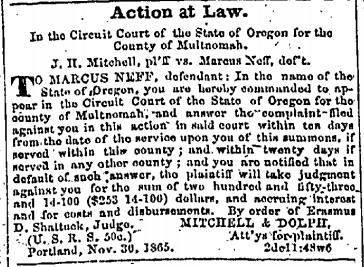
Pennoyer v. Neff noticeThe Hartford Courant reports that the Connecticut state courts will no longer require parties to publish court notices in local papers, effective January 2. Instead, notices will be published in a dedicated court website.

The practice of court notice by publication, sometimes called constructive notice, goes back centuries. It is designed to assure that all interested parties are informed of legal proceedings, especially when those parties cannot be found personally. Indeed, constructive notice played a central role in two of the most famous Supreme Court cases in history. In Mullane v. Central Hanover Bank & Trust Co. (1950), the Court signed off on constructive notice for parties who could not be reasonably ascertained at the time the suit was filed. In Pennoyer v. Neff (1877), the infamous bane of many a first-year law student, the Court based its personal jurisdiction analysis on the premise that constructive notice alone was not enough for the Oregon courts to exercise power over an out-of-state defendant.

Constructive notice is founded on the assumption that if notice is published somewhere, the interested parties are reasonably likely to learn about the proceeding. That itself is a bit of a fiction — the notice in Pennoyer v. Neff was published in a local religious publication called the Pacific Christian Reporter — hardly a paper of major import or geographical reach. But with the unquestioned dominance of the internet in our lives, and the ongoing struggles of the newspaper industry, it is probably more fair to post notices online that in the paper anyway. Newspaper publishers might be rightly angry about the development, but with 2020 on the horizon, it seems sensible for the Connecticut courts to embrace the twenty-first century.

Pictured: The newspaper notice in Pennoyer v. Neff
